

The Nexus Action Theory of Change
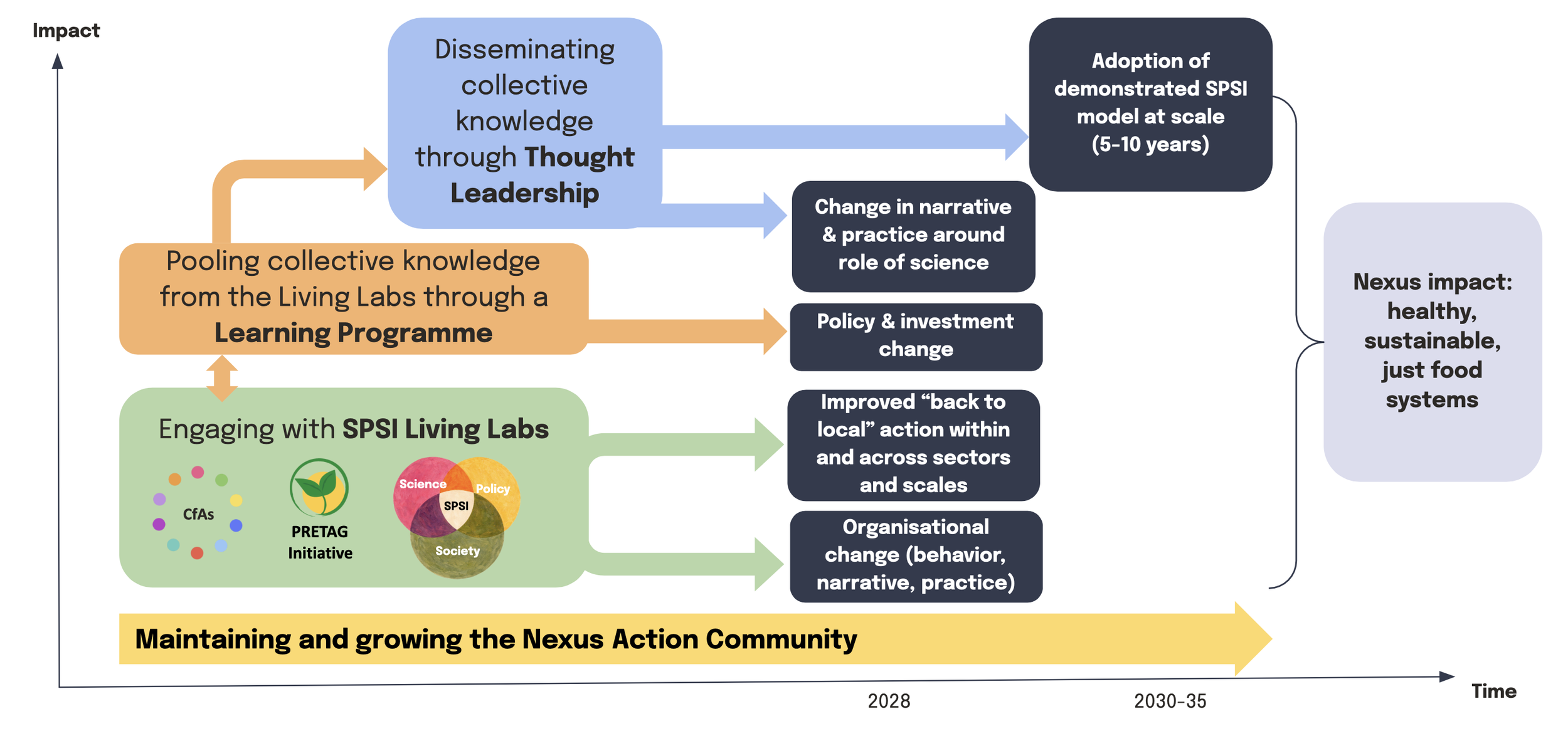
The Nexus Action Theory of Change proposes that inclusive, action-oriented collaboration among science, policy, and society — grounded in local experience and connected across scales — can produce the systemic changes needed to transform food systems and address interconnected planetary and human challenges.
Nexus Action is built on four mutually reinforcing pillars:
Living Labs
Nexus Action works with a diverse range of formal and informal Science–Policy–Society Interface (SPSI) platforms.
These collaborative spaces bring together multiple sectors, scales, and knowledge systems to test ideas, generate evidence, and learn from real-world experience. These Living Labs offer a practical environment for understanding how different forms of knowledge shape action and decision-making, while also revealing how the needs and priorities of action communities influence the production and application of science. By strengthening connections between knowledge and practice, they help food system actors identify effective approaches, address barriers, and improve collaboration for greater impact.
Through these partnerships, Nexus Action examines how SPSIs function in practice and provides guidance, tools, and insights to support their evolution. The Living Labs also capture Stories of Progress that highlight local innovation, knowledge, and lessons emerging from action on the ground. Together, these stories create a growing evidence base for tracking progress, sharing learning, and inspiring transformative change.
Nexus Action currently collaborates with the following Living Labs:
-
At the launch of the 2025 EAT-Lancet Commission ten Communities for Action (CfAs) stood alongside the Commission demonstrating a strong model of science in action and action in science.
Each of these Communities represents a distinct key food system actor group and brings together frontline actors from around the world.
In 2025 each of the CfAs co-developed Action Briefs, shared their Stories of Progress and started to explore cross-community tensions, synergies and potential high impact collaborative actions. The momentum of the CfAs, framed by EAT-Lancet Commission knowledge, lives on and provides a compelling Living Lab for Nexus Action.
Want to engage actively? Reach out to Ismael Erriest at ismael@eatforum.org
-
This nascent Community for Action is co-hosted by Nexus Action and the Club of Rome.
It challenges science to step back and ask some hard questions about its role, function, and focus, encouraging it to take action on how it should be organised, conducted, and mobilised to better support food system transformation through more effective science–policy–society interfaces (SPSIs).
This community includes individuals engaged in existing science-policy interfaces ranging from highly local landscape initiatives to global science-policy interfaces such as the IPCC, IPBES, HLPE-CFS, the EAT-Lancet Commission and the Earth Commission. It currently includes approximately 52 individuals, all committed to making progress on healthy, sustainable and just food systems and to contributing actively to more effective SPSIs.
Want to engage actively? Reach out to Ismael Erriest at ismael@eatforum.org.
-
PRETAG brings together science, policy, and practice in order to lead food systems transformation towards the reduction of synthetic pesticide use mobilising various agroecological levers.
In collaboration with Nexus Action, PRETAG convenes farmers navigating production constraints, health professionals witnessing the burden of exposure, consumers demanding safer food, food retailers and manufacturers concerned about consumer safety, policymakers balancing competing pressures, financers investing in the transition, and scientists providing evidence on risks and alternatives.
Each holds partial knowledge; none can drive transformation alone. Real progress emerges when these communities act as a shared endeavour, learning from one another, building trust, and connecting local action to global change.
Want to engage actively? Reach out to: François-Xavier Cote at francois.cote@cirad.fr
Learning Programme
The Learning Programme aims to better understand how SPSIs can mobilise knowledge for action, particularly in support of food systems transformation. It focuses not only on what knowledge is produced, but also on how it is produced, who is involved, and how it connects to action across scales, sectors, and knowledge systems. It applies frameworks and analytical tools that map how SPSIs enable progress towards resilient, sustainable and just food systems. The Learning Programme’s findings are directly applied in the Nexus Action Living Labs, where they are continuously tested, refined, and adapted to support community capacity-building and peer-to-peer learning.
Building on the FAO guidance on strengthening national SPIs for agrifood systems, FAO and CIRAD are currently working on a framework for assessing national-level SPSI ecosystems. Our Nexus Action task is to adapt and simplify this framework so that it can be applied for initiatives operating at multiple levels including and beyond the national one.
A central shift in perspective with this framework is to move from viewing SPIs as isolated mechanisms, i.e. a single initiative or organization, to dynamic ecosystems.
Based on this recent work a functional SPSI ecosystem is built on the following four pillars that generate a series of questions:
Actors and Organizations: Who are the actors engaged in the SPSI? Do they engage meaningfully and if so how?
Spaces and Processes: How is multi-actor collaboration enhanced through inclusive and equitable spaces? How do these address existing power asymmetries?
Knowledge: Whose knowledge is recognized, used and shared and how? How is a holistic perspective on agrifood systems achieved?
Intermediary Roles: What activities connect all the actors, their knowledge and policymaking? Who enables this and how?
This framework will support Nexus Action in identifying gaps, opportunities, elements of convergence and consistency, within the SPSI ecosystems, while monitoring the effectiveness of a diversity of SPSIs over time.
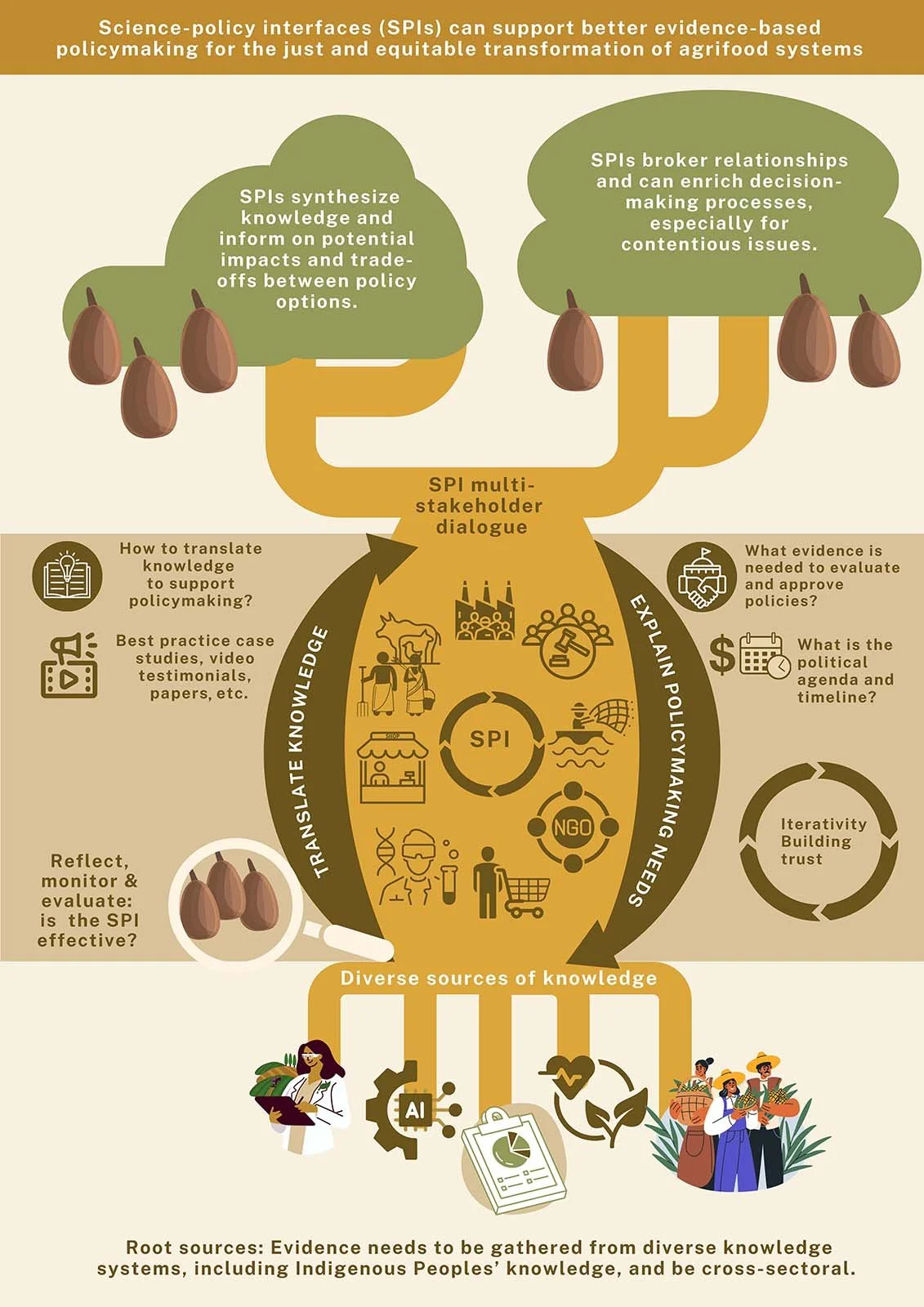
Source: FAO. 2024. Guidance on strengthening national science–policy interfaces for agrifood systems. Rome.
Thought Leadership
Nexus Action Thought Leadership amplifies collective learning for further influence and action. Drawing on the Living Labs and Learning Programme and grounded in front-line actor demand, it identifies where momentum for change is building and where political and institutional openings exist. It also determines which narratives are most likely to shift conversations and culture around collaboration and the role of science, policy, and society in enabling system change, with a clear focus on action towards healthy, sustainable, and just food systems. This includes reflecting the full diversity of actor perspectives, as well as the need to navigate trade-offs and leverage synergies in pursuit of transformation.
This pooled collective intelligence is brought into engagement spaces (national, regional and global) most conducive to action and where the Nexus Action Community has agency. By surfacing Stories of Progress from impactful SPSIs, identifying the narratives that can most effectively drive change, and connecting diverse actors, Thought Leadership gives expression to a new model of Science-Policy-Society interfacing: one designed across sectors, scales, and knowledge systems to enable more effective food systems transformation.
-
![]()
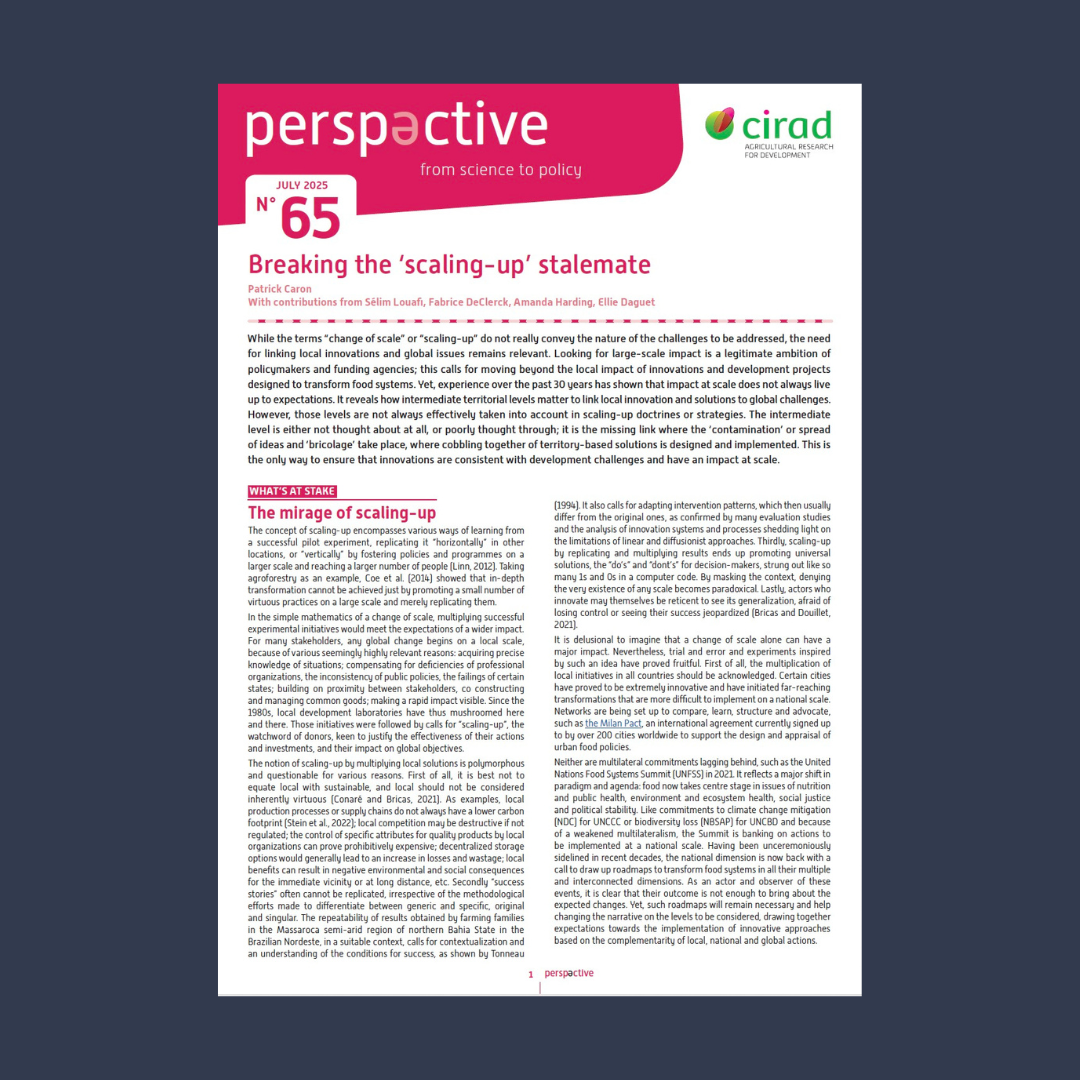
Breaking the “scaling-up” stalemate - Patrick Caron et al. - Perspective CIRAD - 07/2025
Food system transformation requires moving beyond the illusion of simple “scaling up” and instead recognising that change emerges through continuous negotiation between local experimentation, national policy, and global commitments.
-
![]()
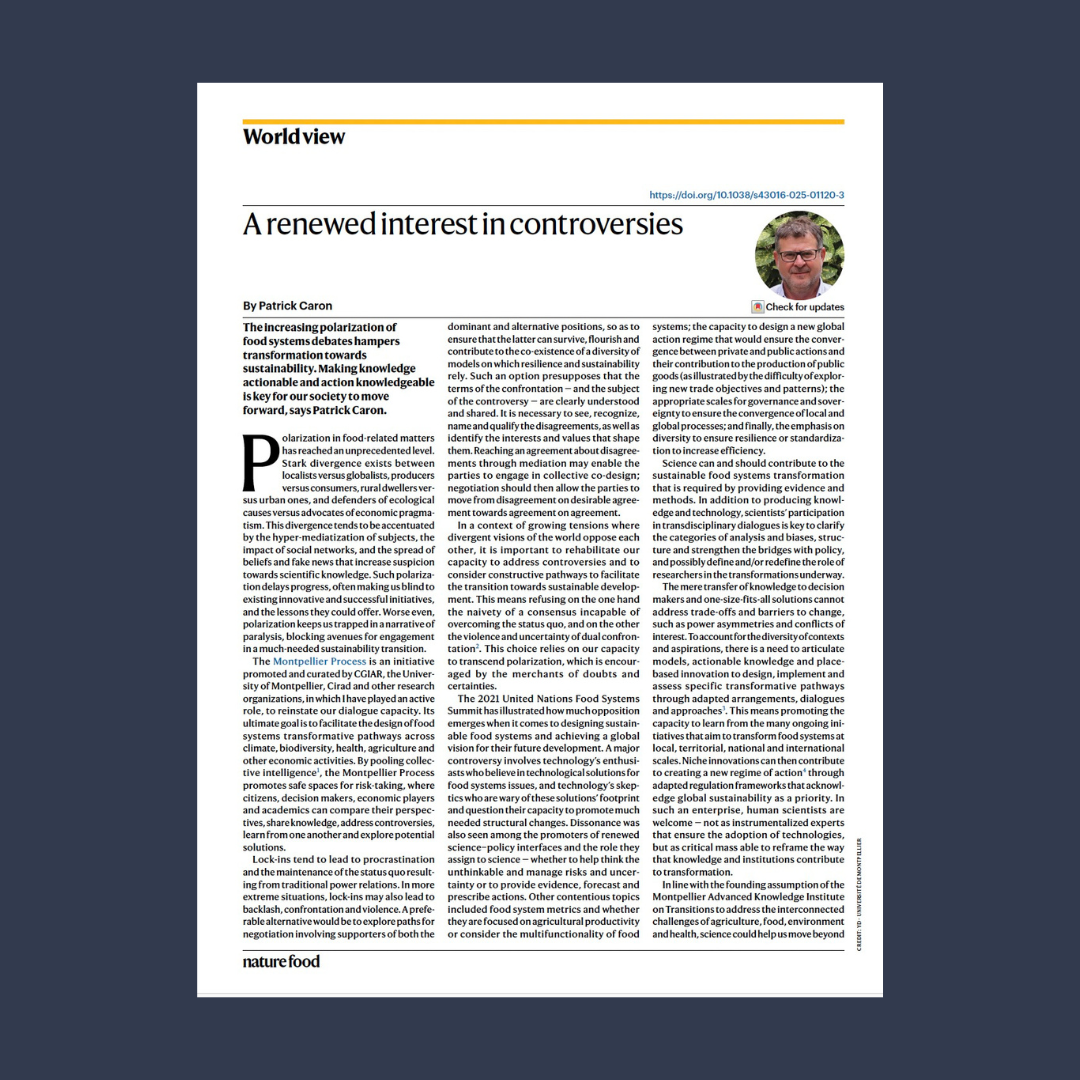
A renewed interest in controversies - Patrick Caron - Nature Food - 02/2025
The increasing polarization of food systems debates hampers transformation towards sustainability. Making knowledge actionable and action knowledgeable is key for our society to move forward, says Patrick Caron.
-
![]()
Pooling collective intelligence to transform food systems - Outcome document - 03/2024
Building on the outcomes of the March 2024 gathering, this document outlines the shared vision, guiding principles, commitments, and pathways for action agreed by participants, establishing a roadmap for more inclusive, effective, and impactful science–policy engagement from local to global scales.
-
![]()
The Montpellier Statement - 03/2022
This statement summarizes the outcomes of the March 2022 Feed-Care-Protect event, calling for stronger collaboration across science, policy, and society to accelerate food systems transformation. It introduces the vision of a shared platform for collective intelligence to address interconnected global challenges.
Community Engagement
At the core of Nexus Action is a global, inclusive, community-owned platform that connects people, knowledge, and action. Its community engagement effort serves as the networking engine, linking actors, learnings, and opportunities across initiatives. It enables participation, fosters relationships, and ensures evidence circulates. Through community management and strategic communication, it upholds accountability, diversity, and long-term resilience, keeping Nexus Action open, trusted, and shaped by its community.
Join the Nexus Action LinkedIn group to stay connected:
Subscribe to our Community Updates via Substack:
Our Journey so far
Our journey started in Montpellier, where over 300 scientists, policymakers and civil‑society actors convened across 2021 - 2022 to confront the gap between the global consensus on radical food‑system transformation and the slow, fragmented reality.
The Montpellier Declaration highlighted two core challenges – enhancing two‑way knowledge flow between science and policy, and leveraging diverse expertise for global policy coherence – sparking the “Montpellier Process,” a platform for continuous, cross‑scale dialogue (LoGloLo). Follow‑up gatherings in October 2023 and a March 2024 summit with 300 experts from 60 countries refined a roadmap, established common principles, and secured concrete commitments.
Today, Nexus Action serves as a global community of practice that unites science, policy and society to accelerate food‑system transformation through inclusive, iterative engagement.
"Bonding Science and Policy to Accelerate Food Systems Transformation" , in preparation for the UN Food Systems Summit.
A round table bringing together African officials from IPCC, HLPE-FSN, IPBES and OHHLEP during the Montpellier Global Days ahead of the New Africa-France Summit.
Feed-Care-Protect: Intelligence to accelerate food systems transformation at local and global level dialogue, leading to the development of a Montpellier Statement.
Publication of a Correspondence in Nature presenting the ambition expressed in the Montpellier Statement.
Montpellier Process Gathering of science and policy leaders co-designing and co-owning the Montpellier Process, with a view to a wider gathering in March 2024, with a Highlights Document shared.
300 scientists, policy makers and civil society representatives from 60 countries gathered to explore how knowledge communities can pool their collective intelligence to accelerate action towards a sustainable future, with food systems as entry points to the interconnected feed-care-protect challenges. March 2024 Outcome Document shared.
The MP at Biodiversity COP16 organised seven linked dialogue events featuring Use Cases from cities, territories, national and global scales. The MPCOP16 Communiqué highlights the nine key messages that will shape the MP going forward.
At Nutrition for Growth Paris, the Montpellier Process held a side event at CIRAD to explore how the nutrition SPSI community can better articulate the challenges and opportunities of food systems transformation for health, justice, and sustainability locally and globally.
An interactive dialogue at the Scientific Advice Mechanism (SAM) Conference in Vienna, Austria spotlighting forward-looking models for science–policy–society interfaces (SPSIs) operating across the feed-care-protect nexus.
At the EAT Stockholm Food Forum, the Montpellier Process will collaborate with the 10 EAT Communities for Action developing Action Briefs in parallel with the launch of the new EAT-Lancet Commission.